MIĻ
NOVEMBER 18, 2025
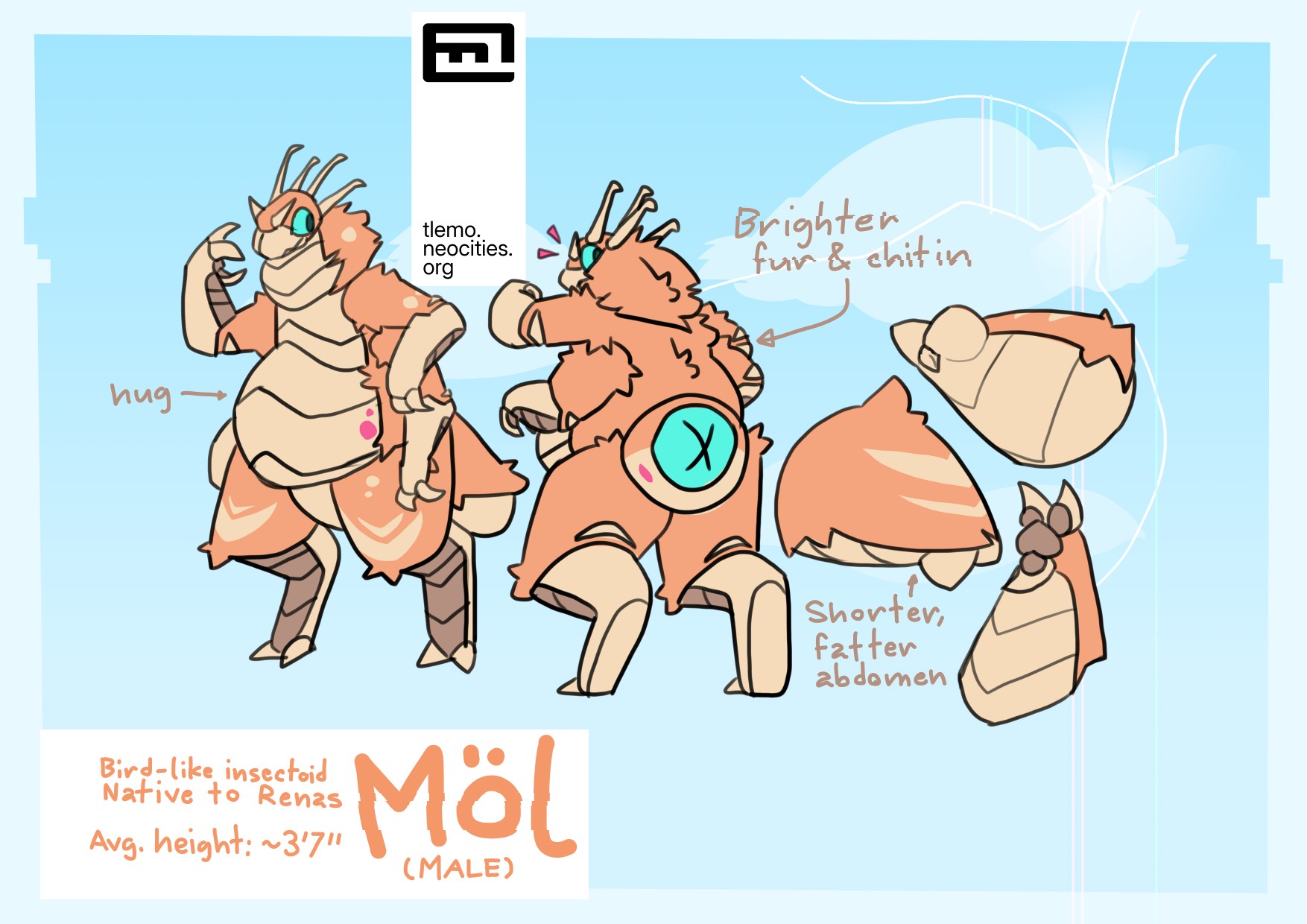
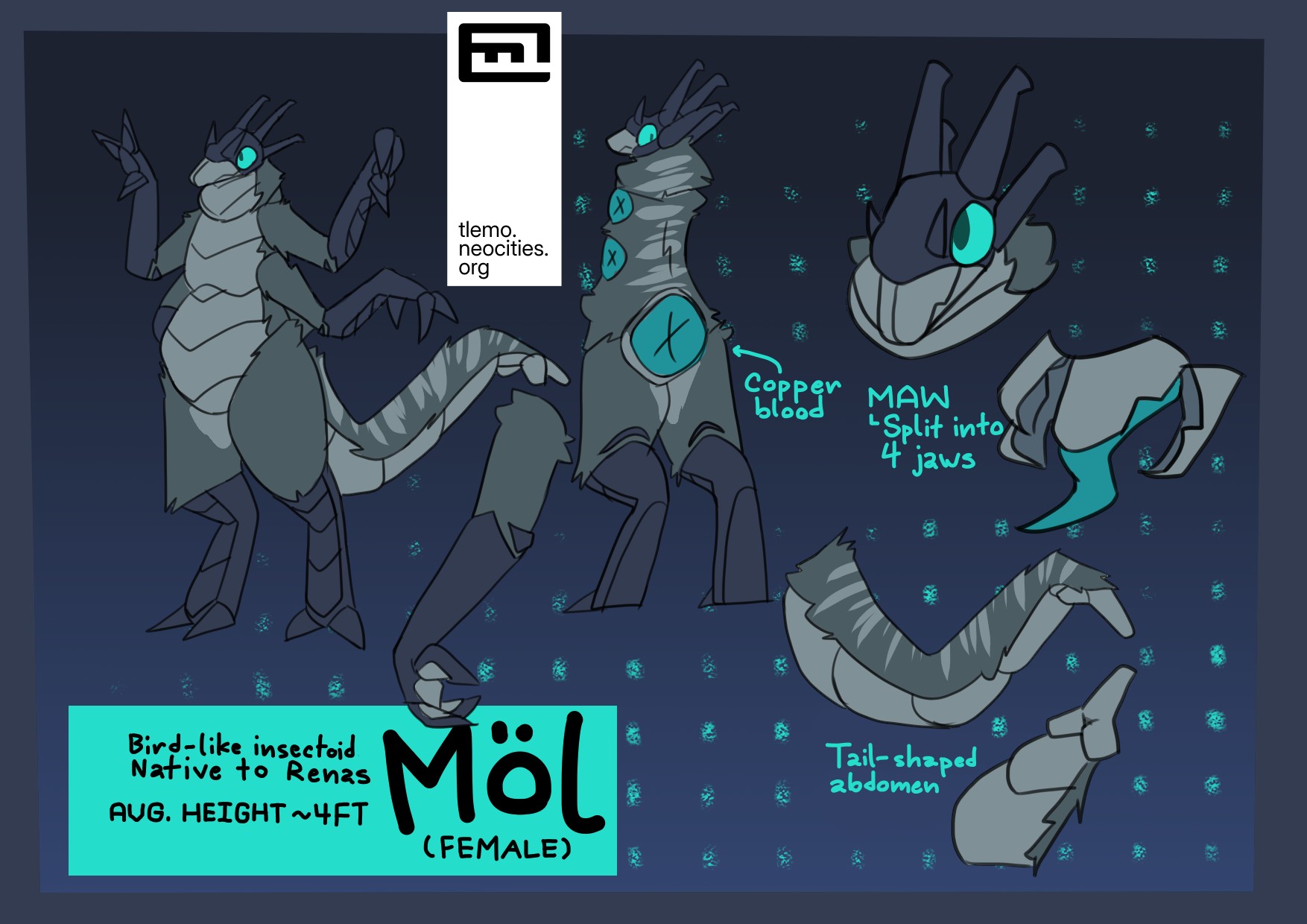
Miļ are a species of anthroporphic sophonts native to Renas. They vaguely resemble insectoid birds, with hair covering most of their body except for the head, arms, legs, and belly. They have a beak that splits four ways, four antennae on the back of their heads, and typically two horns coming out of a lump that lies on top of the beak's base. Their hands have three digits while their feet have just two.
Sexual dimorphism
Miļ have more sexual dimorphism than most other species in the New Bestiary, and male and female individuals tend to look very distinct. Women are taller than men and have darker colors. Both sexes have abdomens, but female abdomens look more like tails than male ones, which are stubbier. The tips of those abdomens are also different; males have two stubby spikes coming poking outwards, while the tip of female abdomens is more spear-shaped.
Resulting culture
This dimorphism is a result of their natural way of life. Miļ culture is almost entirely split between the two genders, which fill different roles and usually live completely different lives from each other. Women are nomads who live abroad, living in groups and only bringing with them their equipment. Men build permanent settlements, equipment, and systems that they share with women. And this is the basis of all Möl culture.
Biology
The Miļ were adapted to jungle environments, and are especially resilient against head and humidity. Their blood is made up of copper and not iron, which makes up a good part of that resiliency. It also causes them to bleed blue, something that is unique to them among other species.
The Miļ evolved from small, tree-dwelling creatures. They managed to keep their arboreal nature, and so you tend to find them in vertical environments-- high up and with plenty of climbing. For the most part, they're fructivores and so most of their food is fruits or sugary food, although they can and have lived off of meat before.
Pre-civilization
The Miļ lived mostly the way they do now; men in makeshift shelters, women abroad in the jungle. This was before they became sapient, so tools weren't a common thing and individuals were mostly isolated. Men typically built shelters near the bases of trees, where they could easily climb up and snag fruits and the occasional prey. Their shelters were often decorated in elaborate ways, using patterns and exotic materials-- whatever the builder could find. They weren't often put in low-lying places like burrows, since they lived in rainforests where these places would easily flood, destroying everything.
The caches of males was often made up of hard fruits. This was before the Miļ learned how to dry food, but the trees in Renas's rainforests often bore fruits with hard shells. Since Miļ can easily crack open nuts with their beaks or hands, they were a common staple for men. That being said, meat and soft fruits were still kept in caches, just not for long-- either the men gladly gave it to women who visited their homes, or they ate it themselves, never usually letting it rot away.
Women often dwelled on the ground, where most men built their nests. They didn't live in shelters of their own, and didn't really need to anyways; they were more resilient than men and could survive, even on the wet jungle floors among predators. In these times, they visited shelters solely to live as temporary mates and to eat the food that men kept. They even occasionally lived with other women, but only if there was enough room and food (which there often wasn't).
Transition to sapience
Once, a drought came and shrunk the rainforests of Renas. The result is that many Miļ had no jungle, which left them out in the open, with barely any trees to depend on, and with barely any prey they could catch.
This very nearly drove them to extinction. To survive, they had to figure out how to live in this exotic environment. In the midst of this drought, Miļ learned how to craft tools and form strategies to hunt and survive. Men grouped together to form communities, bringing more resources to all. Women also grouped together, making them more resilient against whatever came their way. Men often traded their equipment with women, forming a culture with expectations among men and women. As communities grew, people found their own niches to fill-- these professions grew more sophisticated, and technology advanced as a result.
Modern society
The Miļ are a spacefaring species. They formed OrCS, one of the New Bestiary's major factions-- a conglomerate of colonies set up by the Miļ among the cosmos. Representing multiple species is one of OrCS's "missions", but very few natives who survive Möl colonization are equipped to join their ranks. They are simply shoved out of the way by their colonies.
In fact, the Miļ have a reputation for destroying the worlds that they touch. Even their own-- what lives in Renas almost exclusively lives in the arcologies built by the Miļ in an effort to support their unsustainable ways. Every möl eventually finds themselves living in a dirty, crowded world, superheated from smog and electical components. Instead of bothering to fix the problems they've caused, OrCS has chosen to escape them by endlessly conquering worlds. They inevitably ran into ZHOZH and found themselves competing with them for land.
The resulting war has now lasted for over half a century. Casualties are in the hundreds of millions. Welcome to the New Bestiary!
Everyday life
Miļ are very much an abroad species. They're, in fact, likely the most common species in the galaxy, surpassing zhhanun. OrCS is almost exclusively miļ, of course, but there are also many who live under ZHOZH. And there are many who fly neither's banner-- either as pirates or vagabonds.
Miļ women mostly live as members of a military company or ship crew. A select few get to manage one of the two. Men serve in a wider variety of jobs, either living through the stress of management and logistics, or living through the stress of manual labor. But, as with women, a few of them also get to work as executives.
The Problematique
There's a big gap between these two apparent classes-- those who work under OrCS and those who run OrCS. Workers live in dirty, crowded environments that are almost if not completely inhospitable for them. Soldiers are pitted against foes that overpower them. The men and women who rule them don't see any of this, and often live with very few real obligations.
The sociality of Miļ is so strong that, since the dawn of their civilization, they've never had or needed any real governance. OrCS is not a nation or governing body-- rather it's an organization that represents and facilitates cooperation between Miļ worlds. The "corporations" that are a part of OrCS are the result of the Miļ clutering together haphazardly.
These corporations have nothing barring their growth, and so they exploit the worlds they land in. The Miļ are free to live on their own, breaking free of the obligations they're given and dismantling the backbone of their own exploitation. Their failure to realize this is what is continues the suffering of themselves and the species they've put under their wing.